
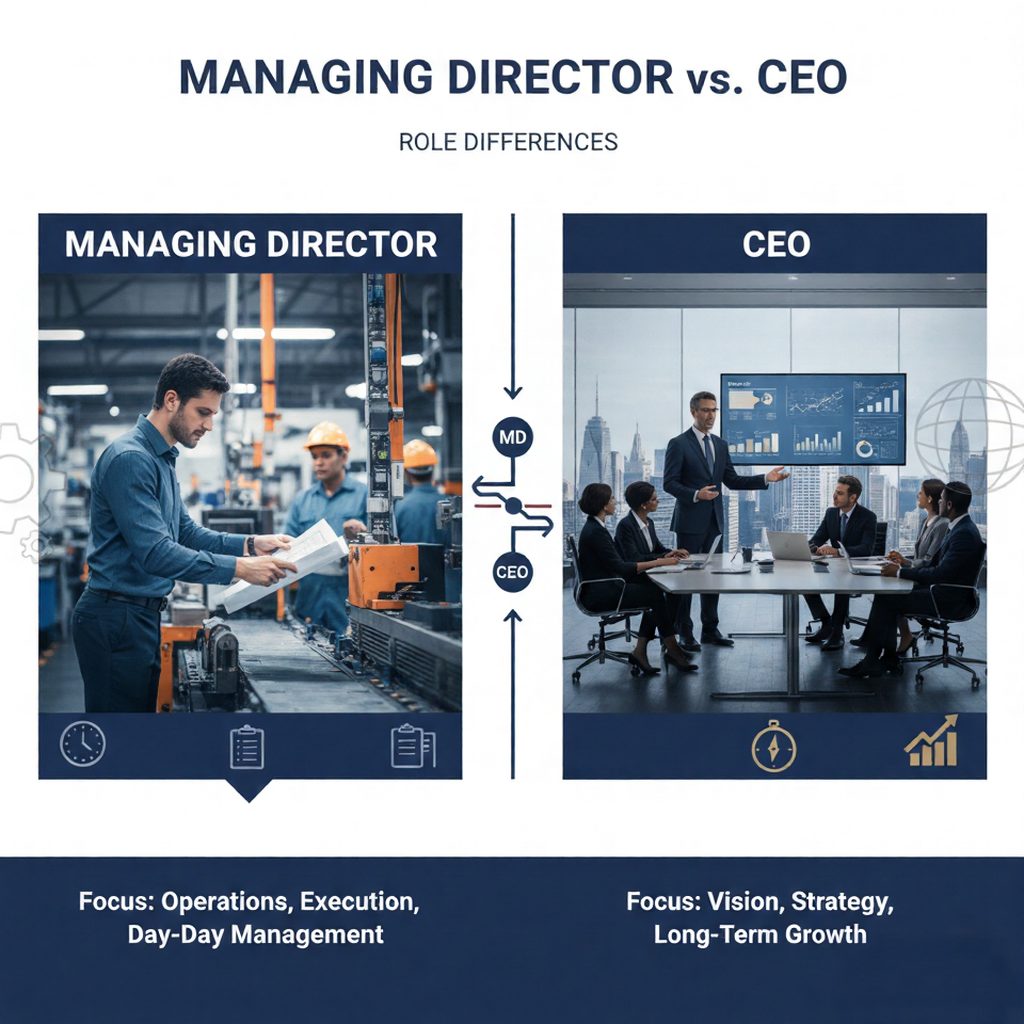
In the modern corporate landscape, leadership titles can be confusing especially when Managing Director (MD) and Chief Executive Officer (CEO) are used interchangeably. While both roles sit at the top of the organizational hierarchy, their responsibilities, authority, and focus areas differ significantly, depending on the company’s structure and geography.
This blog breaks down the key differences between a Managing Director and a CEO, helping founders, board members, and professionals understand who does what and why it matters.
What is a managing director (MD)?
A Managing Director is typically responsible for day-to-day operations and the execution of company strategy. The MD ensures that business plans approved by the board are implemented effectively across departments.
Key Responsibilities of a Managing Director
- Overseeing daily business operations
- Translating strategy into execution
- Managing senior leadership and operational teams
- Ensuring profitability and operational efficiency
- Reporting operational performance to the board
What does a managing director do?
A Managing Director (MD) is a senior executive responsible for running the business on a day-to-day basis and turning strategy into results. If the board and top leadership decide what the company should achieve, the Managing Director focuses on how it actually gets done.
What is a chief executive officer (CEO)?
The CEO is the highest-ranking executive in a company and is primarily responsible for the overall vision, direction, and long-term strategy of the organization. The CEO acts as the key link between the board of directors and the management team.
Key Responsibilities of a CEO
- Setting the company’s vision and long-term goals
- Leading strategic planning and growth initiatives
- Representing the company to stakeholders, investors, and regulators
- Making high-level corporate decisions
- Appointing and overseeing top executives
What does a CEO do?
A Chief Executive Officer (CEO) is the highest-ranking executive in a company and is ultimately responsible for its overall success or failure. The CEO sets the direction of the organization, makes major corporate decisions, and ensures the company is moving toward its long-term goals.
Key Differences Between Managing Director and CEO
| Aspect | Managing Director | CEO |
|---|---|---|
| Primary Focus | Operational execution | Strategic leadership |
| Authority Level | May report to CEO or Board | Reports directly to the Board |
| Daily Involvement | Highly involved in daily operations | Less operational, more visionary |
| Board Position | Often a board member | Typically the top executive on the board |
| External Representation | Limited | Primary spokesperson |
| Geographic Usage | Common in India, UK, Asia | Common globally, especially US |
How to become a managing director?
Becoming a Managing Director (MD) typically requires a blend of high-level experience, strategic vision, and demonstrated leadership. It is rarely an entry-level position and usually involves ascending through senior management roles.
Key Steps to Become a Managing Director:
- Earn Relevant Education: Obtain a bachelor’s degree in business, finance, or a related field. A Master’s in Business Administration (MBA) or equivalent, along with certifications (e.g., Chartered Accountant), is highly preferred.
- Gain Extensive Experience: Acquire 10–15+ years of experience in your industry, progressively moving into senior leadership roles such as Director, Vice President, or General Manager.
- Develop Core Skills: Master strategic planning, financial management (budgeting/forecasting), corporate law, and operational oversight.
- Build Leadership Capabilities: Cultivate strong interpersonal skills, decision-making abilities, and the capacity to lead large teams and drive corporate culture.
- Network and Build a Brand: Establish a strong reputation within your industry, work with mentors, and seek board-level exposure to understand governance.
- Secure the Appointment: Position yourself for promotion by demonstrating measurable results, such as increased revenue or improved profitability. An MD is formally appointed by the Board of Directors.
Looking to strengthen board governance and leadership alignment?
Explore how DESS Digital helps boards and executives collaborate better, make faster decisions, and lead with confidence in a digital-first world.
FAQs
1.Who ranks higher, the CEO or the MD?
In most modern corporate structures, the CEO ranks higher. The CEO is responsible for the overall strategic direction of the company, whereas the MD typically reports to the CEO and handles internal execution.
2.Can the same person be both CEO and MD?
Yes. Many companies, especially startups or firms in India and the UK, combine these roles into a single “MD & CEO” position.
3.What is the primary difference in their daily focus?
The CEO is “outward-looking,” focusing on vision, investor relations, and the company’s public image. The MD is “inward-looking,” managing day-to-day operations, departmental performance, and employee motivation.
4.How do their reporting structures differ?
The CEO reports directly to the Board of Directors. The MD usually reports to the CEO, though in some specific legal structures (like in India), the MD is a board member elected by shareholders.
5.Which role is the public face of the company?
The CEO typically serves as the primary spokesperson for media, investors, and government stakeholders. The MD usually operates “behind the scenes” to ensure operational targets are met.
6.Who makes the major strategic decisions?
The CEO handles high-level, long-term decisions such as entering new markets or major mergers. The MD makes tactical and operational decisions to streamline current business processes.
7.Is one role more common in certain regions than others?
Yes. The title “CEO” is globally dominant, particularly in the US. The title “Managing Director” is more traditional and legally defined in the UK, India, and parts of Asia.
8.How do their salaries compare?
Generally, CEOs receive higher compensation than MDs because they carry the ultimate responsibility for the entire organization’s performance and profitability.
9.Do all companies need both a CEO and an MD?
No. Small businesses often only have one leader (an MD or CEO). Multinational corporations (MNCs) frequently use both, with localized Regional MDs managing specific territories while a Global CEO oversees the entire entity.
10.What are the legal differences between the two?
An MD is often a member of the Board of Directors with specific legal accountability under corporate laws like the Companies Act. A CEO may be a professional hire who is not a director unless specifically appointed as a “Whole-time Director”.