
Introduction
On International Women’s Day 2026, we assess how far we have come in boardroom gender diversity. The United Nations Sustainable Stock Exchanges (UN SSE) along with the International Finance Corporation (IFC) and UN Women released a new suite of ‘Market Monitors’ on March 3, 2026 to provide the latest analysis on gender diversity, equity and inclusion (DEI). This analysis shows stock exchanges, regulators and market participants the present progress, gaps and how capital markets can contribute to a more inclusive corporate leadership.
Background
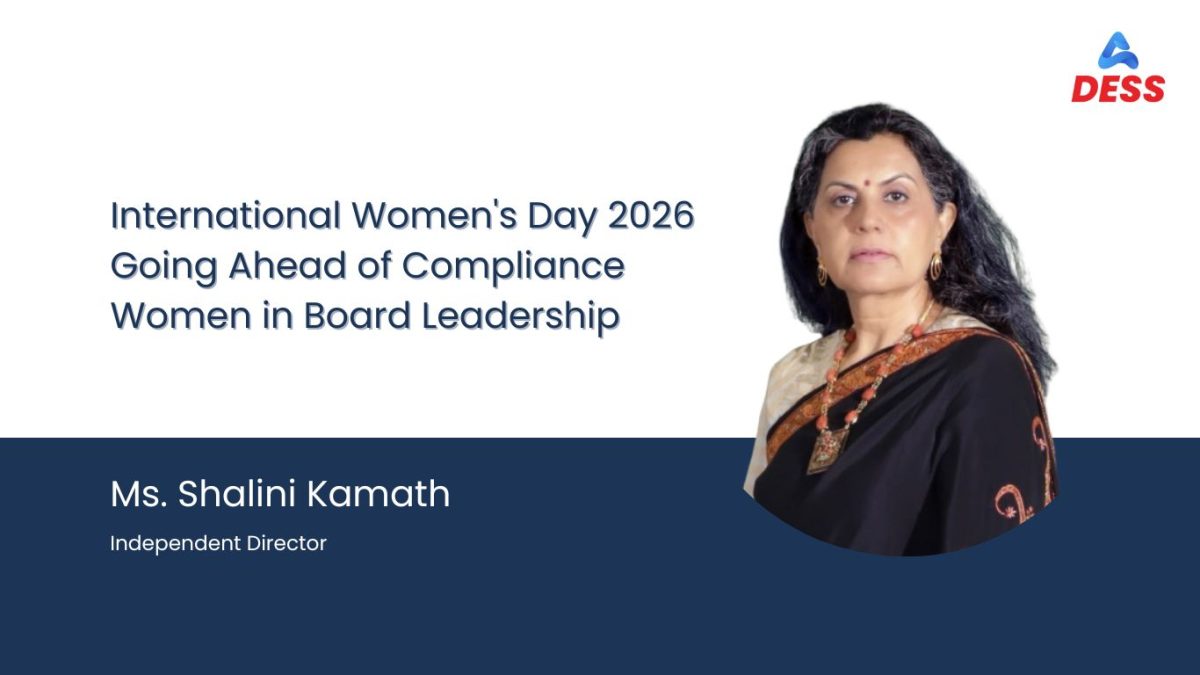
In recent years, corporate boards worldwide have seen a specific focus on DEI through measured implementation. EU’s 2022 Directive mandated at least 40% of non-executive director seats for large EU companies to be held by under-represented genders. Japan’s voluntary national target as a part of its Corporate Governance Code encourages ~30% female board members by 2030. India’s Companies Act 2013 as well as SEBI LODR mandated appointment of minimum one woman director on listed companies and similar mandates are followed by Malaysia as well as South Korea among others. To understand the evolution of board diversity beyond such compliance parameters, we engage in an insightful discussion through this episode with a vastly experienced board leader, Ms. Shalini Kamath.
A Conversation with Ms. Shalini Kamath
About
Ms. Shalini Kamath is a seasoned board member with over a decade of experience serving as an Independent Director across several corporate boards. She is also a transformation strategist and leadership coach with deep cross-sector expertise spanning corporate governance, human capital strategy, and organizational transformation. Ms. Kamath currently serves as an Independent Director on the boards of Abbott India (Healthcare), Expleo Solutions (French IT services), Ambit Finvest (Financial Services), Bosch Home Comfort Consumer Durables), Maple Highways (a Canadian Pension Fund–backed Infrastructure Investment Trust) and Healthium Medtech (a KKR portfolio company). She previously served as an Independent Director at Gujarat Borosil, Graphite India and the non-profit organization TRRAIN (Trust for Retailers and Retail Associates of India).
A respected advocate for strong board governance, Ms. Kamath is the past Chairperson of the FICCI Women on Corporate Boards Mentorship Program. She has also led numerous transformation and leadership coaching engagements across large conglomerates and
multiple sectors including financial services, manufacturing, legal services, logistics, agribusiness and consumer goods. Earlier in her career, she held several senior leadership roles, including Group Head of Human Resources at Chevron Texaco India, Star India, KPMG India, and Ambit Holdings. She also served as Deputy Marketing Director at Raytheon India.
Ms. Kamath began her distinguished professional journey in Southern Africa, working with the governments of Zambia and Botswana on initiatives related to education, social development
and community-based income generation. She holds an MBA from Edinburgh Business School (United Kingdom) and has completed executive training in Change and Transformation at Harvard Business School. She is also an alumna of the Commonwealth Study Conference and a certified facilitator with Zenger Folkman and Hogan Assessments.
A strong voice for effective leadership and inclusive governance, Ms. Kamath brings a rare combination of boardroom insight, transformation expertise and human-centered leadership to the evolving conversation on board effectiveness and diversity.
The Conversation
Q: With reference to different global regulations, how far do you think we have come globally in achieving gender diversity on corporate boards??
Ms. Shalini Kamath: Globally, we have made meaningful progress although the pace remains uneven across regions. Regulatory initiatives in the European Union, Japan and India clearly signal that both regulators and investors now recognize gender diversity as a strategic governance priority rather than just a compliance requirement. In many markets, companies have largely met the mandated requirements but what is encouraging is the gradual shift beyond minimum compliance. On two of the boards I serve on, there are two women directors and on another, there are three of us. This reflects a growing willingness among progressive boards to broaden representation. More importantly, the conversation is evolving from simply having women at the table to ensuring they actively contribute to board deliberations, whether in shaping strategy, overseeing risk or guiding succession planning. In my experience, boards that embrace diversity in a meaningful way often outperform their peers in terms of effectiveness, innovation and organizational culture.
Q: You have mentored women leaders through FICCI Women on Corporate Boards Mentorship Program. What are the key practical challenges and enablers for women aspiring to board roles??
Ms. Shalini Kamath: Today, a number of board mentorship programs are being offered by various organizations and it is encouraging to see more women, particularly younger professionals actively preparing for board roles. Familiarity with board processes, policies, materials and governance best practices have also improved significantly supported by technology-enabled learning platforms and structured training initiatives. While these programs provide valuable mentorship, exposure to board-level decision-making and a deeper understanding of governance requirements, aspiring women directors often continue to face certain practical barriers. These include visibility gaps and limited access to influential professional networks where many board opportunities originate. Ultimately, the most
important enabler is unbiased, merit-based access to opportunities. When selection processes prioritize competence, experience and perspective over traditional networks, it significantly broadens the pathway for capable women leaders to contribute meaningfully in
the boardroom.
Q: Your early work in Zambia and Botswana involved education and community development. How has that experience influenced your approach to corporate governance
over the years?
Ms. Shalini Kamath: I was very young when I worked in these countries and many of my supervisors were women, as women frequently held leadership roles in government and development institutions there. When I returned to India, I was struck by how uncommon that was within corporate leadership at the time. Those early experiences shaped my thinking in important ways. I learned that inclusion, accountability and structured decision-making are not abstract ideals, they are essential ingredients for sustainable outcomes. Working with governments on income-generation and community development initiatives also reinforced the importance of diverse perspectives and strong stakeholder collaboration. Today, when I serve on corporate boards, I apply those same principles. I focus on fostering equitable participation, transparency and clear communication so that every committee and every
director, especially underrepresented voices, have the opportunity to contribute meaningfully to discussions and to the organization’s long-term strategy.
Q: Across your board engagements as well as advisory and leadership roles, what patterns do you see in organizations that successfully implement DEI initiatives?
Ms. Shalini Kamath: Commitment from the top is critical for the successful implementation of any diversity, equity and inclusion (DEI) initiative. When leadership is genuinely committed, these efforts become embedded in the culture and DNA of the organization rather than remaining isolated programs. Successful organizations integrate DEI into their core governance and operational processes instead of treating it as a stand-alone HR initiative. They track progress, measure outcomes and ensure accountability at multiple levels. Boards also play a key role by setting the tone from the top and regularly reviewing data related to inclusion, representation and leadership development.
Q: Moving beyond compliance, what would be a better parameter to measure the participation of women on boards in the future?
Ms. Shalini Kamath: Compliance ensures a foot in the door and regulations have certainly improved the representation of women on boards. However, true progress lies in meaningful participation in board deliberations. In my experience, when women contribute substantively, they are respected as equal participants in board discussions. Women directors also tend to bring a strong sense of diligence, accountability and perspective to governance matters. Going forward, one useful parameter could be to track how many boards and board committees are chaired by women. Leadership roles within the boardroom are a stronger indicator of genuine inclusion than representation alone
Q: How can corporate governance be further improved in companies?
Ms. Shalini Kamath: Interestingly, we are at a point where governance is becoming a strategic priority for many organizations. Regulators such as the Securities and Exchange Board of India (SEBI), Reserve Bank of India (RBI) and Ministry of Corporate Affairs (MCA) have played a significant role in strengthening corporate governance by establishing robust regulatory frameworks, enforcing transparency, protecting investors and ensuring accountability. Progressive companies and boards are also taking proactive steps by instituting structured onboarding processes for directors and defining clear mandates for board committees. In addition, digitization can significantly enhance board effectiveness. When board documentation and routine processes such as board evaluations, minutes approvals and action-taken reports are digitized, boards can spend less time on administrative tasks and focus more on meaningful strategic discussions.
Conclusion:
In response to regulations, the latest research by UN SSE and other sources show that the present state of board gender diversity has significant variation. For instance:
• United Kingdom’s FTSE 350: Women now hold around 43% of board seats with nearly 90% firms meeting or nearing voluntary targets of 40 % female representation
• United States’ S&P 500: Board data indicates that women occupy about 1/3rd of board positions
• India’s Ministry of Corporate Affairs: A January 2026 bulletin says that women account for about 32% of all registered directors with 29% of directors in private 20% in public firms. These statistics suggest a notable increase from earlier years. However, as Ms. Kamath mentioned, these evolving data underscores that while progress is uneven, boards are moving toward a stronger, gender-inclusive governance and the path ahead is to ensure that women participate more meaningfully. With the International Women’s Day 2026, we continue to celebrate and support women whose voices are transforming boardrooms as well as shaping the future.
About Dess
Dess Digital Meetings is the world’s easiest-to-use board portal software solution for paperless board meetings. Leading organizations in over 25 countries prefer Dess as their choice for efficient and effective board management software. Dess believes in enhancing the value of information globally by harnessing unstructured data to empower the right people at the right time using the right technology. With its group of highly competent and motivated people, it has implemented several first-of-its-kind solutions. To know, please click here or write to [email protected]