
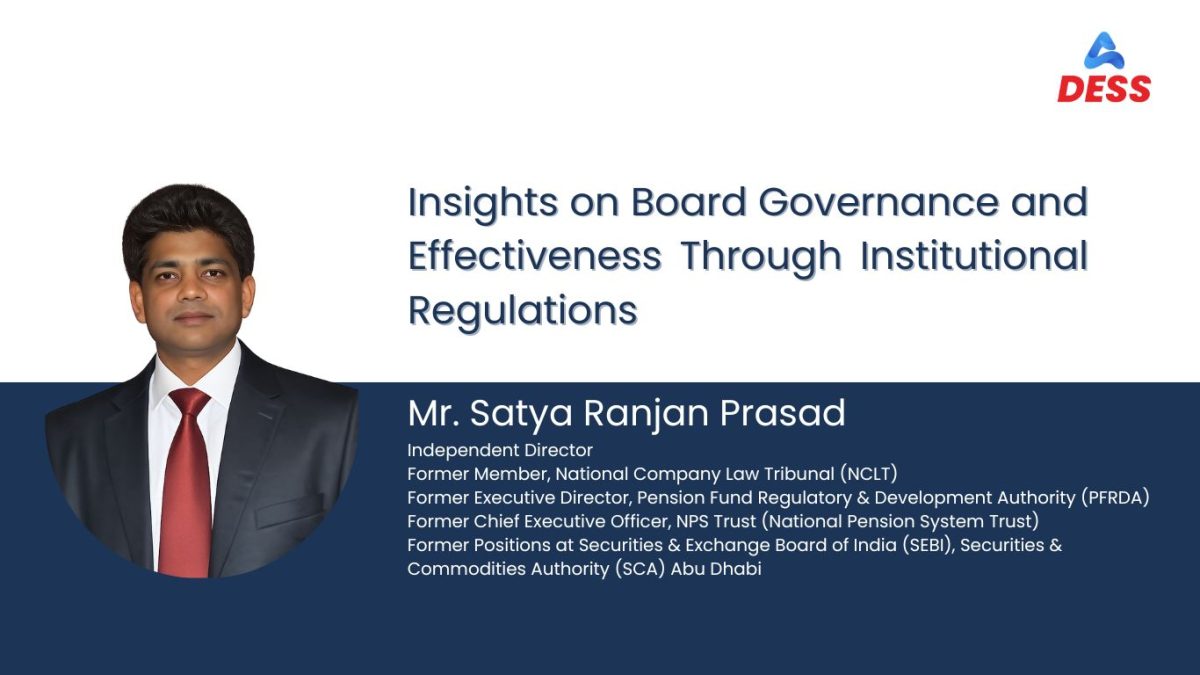
Mr. Satya Ranjan Prasad brings over four decades of experience in financial regulation, institutional governance and corporate adjudication. He is an Independent Director on boards of several prominent organizations and has served as Member (Technical) of the crucial National Company Law Tribunal (NCLT), where he was involved in adjudicating significant corporate and insolvency matters at a quasi-judicial level. Prior to this, Mr. Prasad held senior leadership roles including Executive Director at the Pension Fund Regulatory and Development Authority (PFRDA) alongwith an additional charge as the Chief Executive Officer of NPS Trust (National Pension System Trust). Mr. Prasad was also the Regional Director/Chief General Manager at the Securities and Exchange Board of India (SEBI), shaping policy, supervision and regulatory practice across the financial ecosystem in addition to prior roles at the Securities and Commodities Authority (SCA), Abu Dhabi. Adding to Mr. Prasad’s profound experience, he holds various qualifications including Bachelor’s of Science (B.Sc.), Master’s of Arts (M.A.), MBA (Finance), CAIIB (Certified Associate of Indian Institute of Bankers) and LLB.
In this edition of Dess Discussions, Mr. Prasad shares candid perspectives on what effective boards should prioritise, how leaders can embed governance into strategy and why disciplined decision-making matters in both normal and turbulent times.
Q1: In today’s dynamic regulatory environment, what should boards focus on to enhance their effectiveness?
Mr. Prasad: Board management needs not only compliance checklists but also focus on strategic governance. Boards should anticipate risks, understand emerging trends and align governance practices with long-term organisational goals which build shareholder confidence. This means structured review of risk frameworks, ensuring the right metrics reach the board early and fostering a culture of inquiry where directors ask not just “what happened” but “why and what next”. Effective governance starts with clarity of roles, timely access to information and a continued commitment to engage deeply to resolve issues.
Q2: With vast amounts of information available today, how can directors ensure they are focusing on what really matters?
Mr. Prasad: I believe the challenge is not lack of data, I believe it is distilling insight from noise. Boards must insist on concise, relevant reporting that highlights trends, risks and opportunities. Consistent dashboards, early warning indicators and forward-looking measures help directors shift from retrospective analysis to proactive decision-making. With emerging trends of AI and machine learning, it should be easier for directors to also seek context such as understanding the “story behind the numbers”, so that discussions at board meetings are more meaningful.
Q3: How should boards integrate regulatory compliance into their strategic thinking rather than treating it as a separate function?
Mr. Prasad: Regulatory compliance should increasingly be a part of the board’s strategic conversations. Boards should regularly review regulatory shifts, understand implications for the business and incorporate compliance considerations into strategy discussions early on. When compliance teams are positioned as strategic partners, organisations benefit from better stakeholder trust. This also strengthens risk management and aligns compliance with performance objectives.
Q4: Drawing on your experience at the NCLT, PFRDA and SEBI, what guidance would you offer to organisations seeking to balance sustainable growth with strong governance?
Mr. Prasad: I have seen that growth for all stakeholders can be driven by documentation and deliberation. Boards often engage in rich discussions but meaningful progress happens through execution. This happens when board discussions are clearly recorded, delegated and consistently followed through. This documentation should capture the intent, reasoning and very importantly, foresight. In regulatory contexts, well-documented discussions including rationale and constructive dissent demonstrate that governance in line with business strategy is thoughtful and built for long-term value.
Q5: In your view, what practical steps can boards take to strengthen governance without adding unnecessary complexity to board processes?
Mr. Prasad: One of the easier ways to bring consistency and clarity is to see how board decisions are prepared, discussed and followed up. With technology such as a board portal, agendas, papers, deliberations and action items can be systematically organised and easily accessible. This can help boards focus more on the quality of discussion rather than processes or gaps. This kind of structured approach improves accountability and ensures that decisions translate into timely execution, all of which are essential for strong governance.
Q6: What key qualities should future leaders cultivate to navigate regulatory complexity?
Mr. Prasad: The board of directors should cultivate curiosity coupled with discipline. Technical knowledge is foundational but leaders who stay curious about emerging trends, uncomfortable questions and unseen risks are best equipped to guide their boards. During my tenure, I have seen various organizations who could have easily avoided non-compliance with minimal efforts. Discipline in decision-making, in governance processes and in following through on commitments builds credibility. In uncertain times, organisations look to board directors who balance insight with integrity.
About Dess
Dess Digital Meetings is the world’s easiest-to-use board portal software for paperless board and committee meetings. Leading organizations in over 25 countries prefer Dess as their choice for efficient and effective board management software.
Dess believes in enhancing the value of information globally by harnessing unstructured data to empower the right people at the right time using the right technology. With its group of highly competent and motivated people, it has implemented several first-of-its-kind solutions.
To know, please click here or write to [email protected]